
The Internet Isn't in the Cloud. It's on the Ocean Floor — And Four Companies Just Bought Most of It.
About 530 cables carry 99% of the world's data. A dozen chokepoints could break most of them. And the companies that now own the cables aren't telecom companies anymore.

I'm Victoria — an Economics student and the founder of Axis Brief. Every week I break down one major shift at the intersection of AI and global power through the lens of economics. Not to inform you. To equip you.
“The cloud” is one of the most successful marketing terms in the history of technology. It suggests something weightless, distributed, everywhere and nowhere at once.
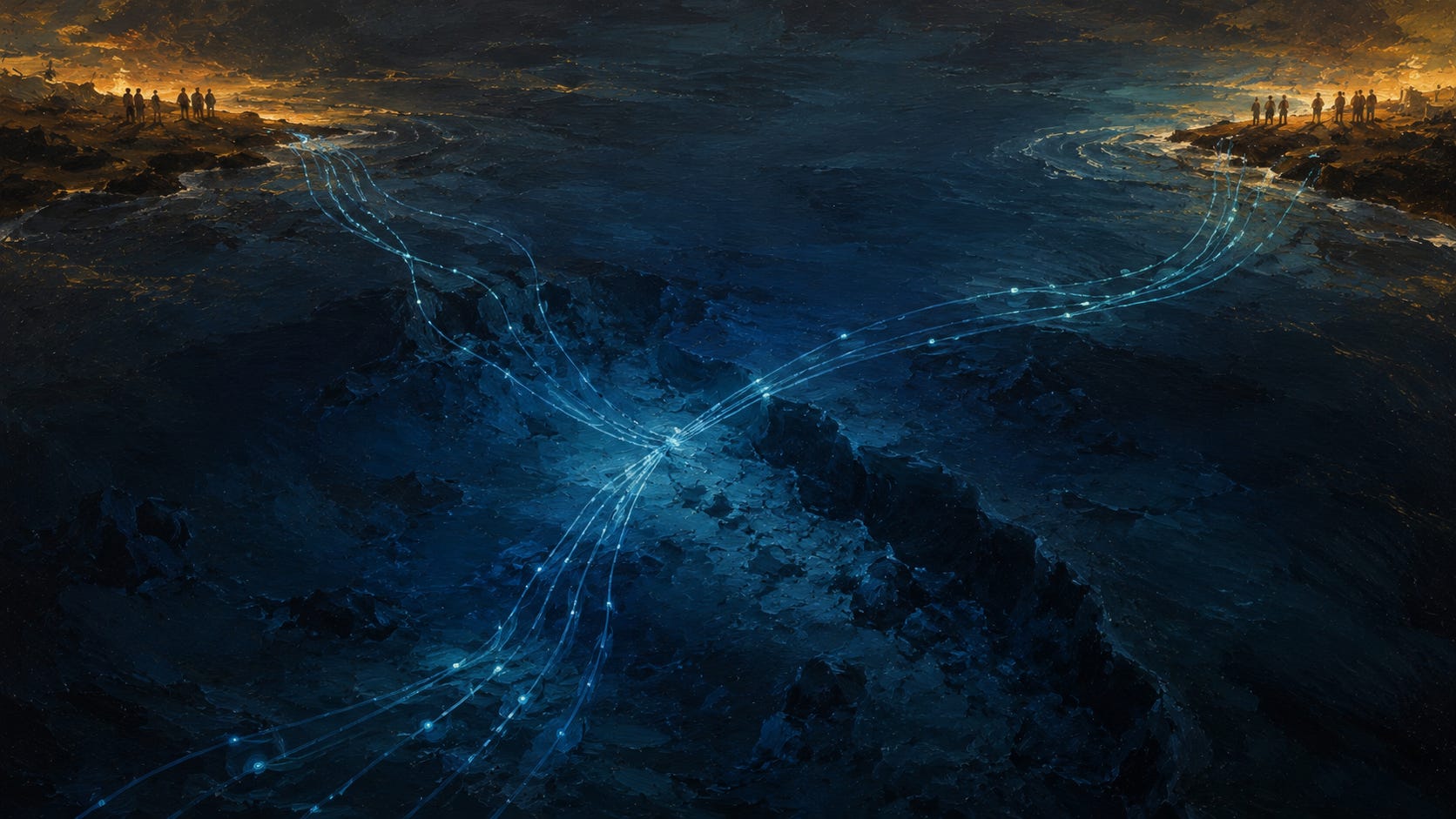
The reality is the opposite. Nearly every email, video call, financial transaction, and AI query that crosses an ocean travels through one of approximately 530 fiber optic cables lying on the seafloor — cables that are, in places, narrower than a garden hose. These cables carry an estimated 99% of intercontinental data traffic. Satellites — for all the attention they receive — carry a fraction of a percent.
The internet is not a cloud. It is hardware. Specific, physical, geographically located hardware that someone owns, someone built, and someone could damage.
Understanding who owns that hardware — and where it’s most vulnerable — is rapidly becoming one of the most consequential economic questions of the AI era.
The Geography That Cannot Be Changed
Undersea cables don’t connect continents directly. They funnel through chokepoints — narrow geographic corridors where the physical realities of ocean depth, coastlines, and existing infrastructure force dozens of cables into close proximity.
The Red Sea and the Bab-el-Mandeb Strait between Yemen and Djibouti carry an estimated 17 to 20 percent of global internet traffic between Europe, Africa, and Asia through a corridor a few dozen kilometers wide. In 2024, several major cables in this corridor were damaged — widely attributed to ship anchors in an area where Houthi attacks on shipping had already created instability. The economic disruption rippled through internet connectivity across the Middle East and East Africa for weeks.
The Singapore Strait performs a similar function for Asia-Pacific traffic — one of the densest concentrations of subsea cables on Earth, all passing through waters shared by some of the busiest commercial shipping lanes in the world.
The Taiwan Strait carries cables connecting East Asia’s major economies, in waters where commercial shipping, fishing fleets, and naval activity from multiple nations already overlap — and where cable damage incidents near Taiwan’s outlying islands have occurred multiple times in recent years, attributed variously to anchor drags and, in some cases, suspected deliberate activity.
The Baltic Sea has experienced a cluster of cable and pipeline damage incidents since 2023, prompting NATO members to increase naval patrols specifically to protect undersea infrastructure — an unprecedented peacetime allocation of military resources to protect fiber optic cables.
Here is the economic reality these incidents reveal: most cable damage is not sabotage. It is anchors, fishing equipment, and underwater landslides — mundane accidents that happen routinely. But because so many cables converge in so few corridors, even mundane accidents can have outsized consequences. And in regions where geopolitical tension is already elevated, the line between “accident” and “deniable gray-zone action” becomes economically and strategically blurry — which is itself a cost, regardless of what actually happened.
This geography cannot be re-engineered. The ocean floor’s depth contours, the location of continents, and decades of existing infrastructure mean new cables tend to follow similar routes to old ones. Chokepoints are not a temporary feature of the system. They are the system.
The Quiet Privatization Nobody Is Discussing
Here is the part of this story that receives almost no attention — and is, economically, the most significant.
For most of the history of undersea cables, ownership followed a consortium model. Multiple telecommunications companies — often dozens, sometimes representing different countries — would jointly fund a cable, share its capacity, and operate it as something closer to a shared utility than a private asset. This model reflected the economic reality that undersea cables were expensive, slow to build, and most valuable when shared broadly across many users.
That model is being replaced.
Google, Meta, Amazon, and Microsoft — the four largest cloud and AI infrastructure companies on Earth — have become the largest owners and lessors of undersea cable bandwidth in the world. Estimates suggest these four companies now own or control roughly half of all undersea cable bandwidth globally, a dramatic shift from a decade ago when telecom consortia dominated.
Some of this is leased capacity on consortium cables. Increasingly, it is wholly owned private cables — built by and for a single company, to move data between that company’s own data centers at the scale and latency its AI infrastructure demands.
Why does this matter economically? Because undersea cables were, for seventy years, infrastructure that approximated a public good — expensive to build but broadly shared, with governance structures involving multiple stakeholders and, often, multiple governments. As that infrastructure shifts toward private ownership by a handful of companies whose primary motivation is optimizing their own AI and cloud workloads, the economic incentives shift too.
A consortium cable’s economics depend on broad usage across many customers. A hyperscaler’s private cable economics depend on serving that hyperscaler’s own infrastructure most efficiently — which may or may not align with broader connectivity goals for the regions the cable passes through.
This is not a conspiracy. It is the rational economic response of companies whose AI infrastructure has outgrown what shared infrastructure can efficiently provide. But it represents a quiet transfer of control over the physical substrate of the global internet — from a broadly governed shared resource to the private infrastructure decisions of four companies headquartered in one country.
The China Dimension — Bifurcation Returns
If this pattern sounds familiar, it should. We’ve now seen it in semiconductors, in AI chip supply chains, and now in the physical cables that carry the data those chips process.
China’s HMN Technologies — spun out of Huawei’s marine networks division after Huawei faced Western sanctions — has rapidly become one of the world’s major cable-laying companies, central to China’s Digital Silk Road initiative connecting Chinese-built digital infrastructure across Africa, Southeast Asia, and Latin America.
In response, the United States and allied governments have increasingly pushed back on HMN-built cables landing in or near allied territory, citing espionage and data-security concerns — concerns that mirror, almost exactly, the language used around Huawei’s 5G equipment several years earlier. Alternative cable projects — backed by US, European, and allied capital and explicitly positioned as alternatives to Chinese-built infrastructure — have been announced across multiple regions.
The result is the same bifurcation pattern we examined in the semiconductor industry. Two parallel sets of physical infrastructure, built by different consortia, serving overlapping but increasingly separate digital ecosystems. A cable is, in this sense, not so different from a chip — it is infrastructure whose ownership and routing now carries strategic weight that has little to do with its technical function.
The Counterargument — Redundancy Is Real
The honest counterargument to all of this is that the industry knows about these vulnerabilities and is responding to them with real capital.
Investment in new subsea cable capacity is at record levels — tens of billions of dollars in announced projects, driven substantially by AI infrastructure demand. New routes are being designed specifically to avoid traditional chokepoints where possible. Mesh topologies — where data can reroute through multiple paths if one cable fails — are increasingly standard for new builds. Hyperscalers building private cables often build redundant pairs specifically to avoid single points of failure within their own networks.
This is genuine progress, and it matters. The internet of 2030 will likely be more resilient, in aggregate, than the internet of 2020.
But redundancy and chokepoints are not mutually exclusive. You can build ten new cables through the Red Sea corridor and the Red Sea corridor remains a chokepoint — you’ve simply raised the number of cables that would need to be damaged simultaneously to cause a major outage. Geography sets a floor under the risk that capital investment can reduce but cannot eliminate.
The most likely outcome by 2030 is the same pattern we keep encountering in this newsletter: meaningful mitigation, persistent underlying vulnerability, and a system that is more expensive and more resilient than before — but not fundamentally less concentrated at the points that matter most.
Three Economic Signals Worth Watching
Hyperscaler cable ownership disclosures. Google, Meta, Amazon, and Microsoft increasingly disclose their subsea cable investments in infrastructure announcements and sustainability reports. Track the share of new global cable capacity these four companies own outright versus lease — rising private ownership signals an accelerating shift away from the consortium model.
Chokepoint incident frequency and response time. Every cable damage incident in the Red Sea, Baltic Sea, and waters near Taiwan generates repair-time data. Repair times in contested waters have lengthened in recent years due to access and safety concerns. Lengthening repair times in any of these regions signal that geopolitical tension is beginning to directly degrade infrastructure resilience.
HMN Technologies contract wins versus Western alternative cable announcements. Every new cable project in Africa, Southeast Asia, or Latin America now functions as a small proxy contest between China’s Digital Silk Road and Western-backed alternatives. The win rate on each side over the next several years indicates how quickly the bifurcation pattern is spreading from semiconductors into physical internet infrastructure.
Follow the ownership filings. Not the ribbon-cutting ceremonies.
What This Means
The internet’s physical infrastructure has quietly become one of the most economically significant pieces of real estate on Earth — and almost nobody thinks about it, because “the cloud” was designed to make you not think about it.
Four companies now control roughly half the bandwidth that carries the world’s data between continents. A dozen narrow corridors on the ocean floor carry the overwhelming majority of that traffic. And the same bifurcation reshaping semiconductors is now reshaping the cables themselves.
None of this requires anything dramatic to matter. It requires only that the current trajectory continues — more AI demand, more private cable ownership, more geopolitical tension in the same handful of corridors that have carried this traffic for decades.
Most people will only think about undersea cables the day one of these corridors fails and a continent’s internet slows to a crawl.
Axis Brief exists so you understand the structure before that day arrives.
Next week: data centers — the new oil, and the most fought-over real estate of the AI economy.
— Victoria, Axis Brief